
Defensive trench systems and barriers (AI-generated illustration)
The EU has taken an important step by agreeing on €90 billion in joint borrowing for Ukraine. Yet this alone will neither stop Russia nor secure Europe, and it will not be sufficient for Ukrainian needs. It is, however, a decisive move in the right direction (consistent with the original Estonian plan) and, together with other December decisions, it lays the groundwork for innovative next steps, including the use of immobilised Russian assets. Combined with strong bilateral defence commitments through 2026, this should mark the beginning of a serious budgetary scale-up in response to Russian aggression.
Importantly, the December decisions also showed that the EU can overcome the unanimity constraint and long-standing political taboos. Member States should now build on this momentum by advancing work on Russian assets and further expanding the joint borrowing instrument.
Revision 2: Based on expert input, we have prepared a more balanced version of the document. It places greater emphasis on exploring additional options for using immobilised Russian assets. While Europe remains divided, discussions are progressing. By accelerating these efforts, developing further innovative solutions (as outlined in the final section of this report), and building on the December 2025 decisions, we can establish an effective way forward.
Table of contents
- Background
- Overview of funding sources for Ukrainian defence in 2026 and beyond
- Russian military spending and situation
- Ukrainian defence spending and goals
- Important notes: defence spending efficiency and capacity
- Summary tables for 2026: Russian war spending, Ukrainian funding, and optimal defense figures
- Summary and call to action
- General points on defence investment
Background
Significant EU decisions were made in December 2025, when Russian assets were ‘deep-frozen’ and the most urgent Ukrainian needs were addressed through €90 billion in joint EU borrowing. It was after Belgium, Italy, and other countries rejected a ‘reparations loan’ linked to the frozen Russian assets. Many saw this rejection as a setback for European resolve, but the the Council requested that the Commission explore additional options for leveraging immobilised russian assets. Together with next steps in this field it can be combined with strong EU joint borrowing. For illustration, during the COVID-19 pandemic the EU agreed to jointly borrow around €800 billion to fund its post-pandemic recovery and stimulus package.
However, time is once again of the essence. According to estimates cited during EU discussions, total external financing needs for the Ukrainian budget (including defence costs) in 2026–2027 amount to roughly €135 billion. Even this figure reflects only essential funding and is likely insufficient to halt Russian advances or reverse the situation on the battlefield.
Scope and core argument
This article focuses on the external funding Ukraine needs for a successful defence, beyond the content of €90 billion recently approved by the EU. It also highlights the unique opportunity to strengthen Ukrainian (and therefore European) defence by building on recent breakthroughs that have overcome long-standing political limitations.
Breaking political taboos in December 2025
Beyond the financial scale, the December decision marked important political milestones:
- Overcoming unanimity constraints – Hungary, Slovakia, and the Czech Republic opted out, thanks to ‘enhanced cooperation‘ by the other Member States under EU law (Article 20) — a novel approach in the field of EU budgetary measures.
- Joint debt for defense is no longer taboo: It also pushed past long-standing opposition to joint borrowing from traditionally “frugal” EU countries, including Germany, the Netherlands, and the Nordic states. Their leaders deserve credit for prioritising European defense and collective security over long-held fiscal reservations.
- Emergency clause activated in response to the Russian war: The above-mentioned deep-freeze was implemented using an emergency clause (Article 122), bypassing the six-month renewal cycle. This frees up EU negotiating capacity and reduces the risk of political blackmail by individual leaders, such as Viktor Orbán.
- European Council leaves itself with explicit recourse to Russian frozen assets: The December Council Conclusions state that the EU reserves the right to have recourse to Russian frozen assets to repay the Ukraine Support Loan should Russia fail to pay reparations. This is the first time the EU has acknowledged a right in accordance with European and international law to have recourse to Russia’s frozen assets – even if it has not chosen to exercise such a right yet. Along with the ‚deep freeze‘ on the assets, this recourse further establishes that the frozen assets will only be returned to Russia if it pays the reparations it owes Ukraine for reconstruction.
Overview of funding sources for Ukrainian defence in 2026 and beyond
To evaluate the projected funding gap for 2026 and beyond, this section outlines the various external military aid mechanisms—ranging from bilateral grants to the G7-led loan initiatives.
Military assistance to Ukraine in 2025 and estimated bilateral assistance in 2026
According to the Kiel Institute, support provided by European countries in 2025 has failed to fully offset the drop in US aid. By October 2025, only €32.5 billion had been allocated, and if the pace of earlier months were maintained, total support for the year would reach only around €37 billion. That includes commitments of countries towards the PURL instrument. The tracker also includes assistance provided through the European Peace Facility (EPF) and the Ukraine Assistance Fund (UAF).
However, according to Ukraine’s Ministry of Defence, total military assistance in 2025 reached a record €45 billion, representing a 30% year-on-year increase. The difference compared to Kiel Institute data is likely explained by the timing of the reports and differences in calculation methods.
Bilateral commitments for 2026 include a record €11.5 billion pledge from Germany, alongside €7.3 billion from Norway, €5 billion from the United Kingdom, around €2 billion from the Baltic states and Canada combined, and a further €5 billion from Denmark and the Netherlands. In total, known and publicly announced commitments exceed €31 billion.
The latest EU joint borrowing
Under the EU proposal, the €90 billion loan would cover financial needs of Ukraine for the next two years, with approximately €60 billion dedicated for military spending and the remaining €30 billion intended to support Ukrainian national budget. The instrument created is called Ukraine Support Loan.
Therefore, we can count from this instrument roughly half of €60 billion for 2026 for military purposes.
Military assistance under the SAFE mechanism
The SAFE instrument adopted 27th of May 2025, meanwhile, is expected to generate only around €5 billion for Ukraine — a marginal contribution relative to wartime needs. As Transatlantic dialogue article explains, Ukraine is not eligible for SAFE loans, and while Ukrainian firms may participate in joint procurement as subcontractors, eligibility rules significantly limit this pathway.
For 2026, due to limited available information and to avoid double-counting with the commitments mentioned above, the overview table below uses a conservative estimate of €2 billion.
ERA, G7 instrument of €45 billion from 2024
The G7’s Extraordinary Revenue Acceleration (ERA) mechanism, adopted in 2024, provides Ukraine with roughly €45 billion ($50 billion) in loans backed by future profits from frozen Russian sovereign assets. In November 2025, there was announced final EU tranche of this instrument. EU has finalized its roughly $20 billion contribution and already in 2024, USA has transferred its part, also $20 billion to the Invest in Strengthening Ukraine Financial Intermediary Fund (F.O.R.T.I.S. Ukraine FIF). It is not entirely clear what part is remaining to disburse from non-EU countries in 2026 for defense. Conservative calculation can be €3 billion.
Why ERA cannot be extended and what shall be done next
While effective as a one-off emergency instrument, ERA cannot be easily extended, as it is limited by the finite returns generated by the frozen assets.
Revision 2 – Note: Researchers argue that there should be no additional legal risks associated with using the principal of frozen Russian assets; this should now be considered a natural next step.
https://libmod.de/legal-analysis-reparations-loan-ukraine/
Since 2025, as noted above, the debate has focused on whether the full value of the assets could support a so-called “reparation loan” without formally using the principal, including to refinance ERA. That approach was so far rejected, and the gap was instead filled by the mentioned EU joint borrowing approved at the European Council summit in December 2025. This point is expanded upon in the final recommendations section of this report.
For a more in‑depth analysis, there is the CEPA report Wartime Assistance to Ukraine: The Successes, Failures, and Future Prospects of US and EU Support Models.
Russian military spending and situation
Before we look at what Ukraine needs, it’s worth considering the situation on the Russian side — after all, all this spending is meant to respond to Russian war.
Russian yearly military spending
According to the Stockholm International Peace Research Institute (SIPRI), Russia’s total planned military expenditure for 2025 was estimated at 15.5 trillion rubles (approximately $145 billion). This represents a real-terms increase of 3.4% over 2024 and is equivalent to roughly 7.2% of Russia’s Gross Domestic Product (GDP). SIPRI analysts emphasize that the official „National Defence“ budget chapter has become an increasingly unreliable proxy for total costs, as a growing share of war-related spending—including social support for veterans and the maintenance of occupied territories—is now distributed across other budget categories or remains classified.
Officially, spending on national defence is set at 12.93 trillion rubles ($161.6 billion) in 2026. But actual outlays, including classified spending, are likely to be higher.
Russian economic outlook: facing a breaking point
Russia is under growing financial pressure. According to commentary by Ivan Mikloš, an economist and former Slovak finance minister, Russia is increasingly running out of money and has very limited options to borrow on international markets. Rising costs of military operations, combined with sanctions, low oil prices and restricted access to global financial systems, are squeezing Russia’s budget and constraining its ability to sustain its war effort. While China and some other countries contribute to Russia’s war effort via supply chains, they are reluctant to fund it directly.
There are also estimates of a potential banking crisis by the end of 2026. Moscow is reportedly facing its most severe financial strain since 2022, and its aggressive actions and rhetoric may be a reflection of this pressure.
Despite these pressures, Russia continues to prioritise military expenditure, sustaining a war economy that Ukraine — and Europe — must be prepared to counter. All of the above highlights that investment in Ukrainian defense is highly meaningful — it’s not just Ukraine under financial pressure; Russia is operating at the limits of its financial capacity.
Ukrainian defence spending and goals
2025 budget and defence
In 2025, Ukraine’s national security and defence spending is projected to reach approximately 2.6 trillion UAH (roughly $64–65 billion). This represents roughly 31% to 34% of the country’s projected GDP.
For 2026, Ukraine’s state budget anticipates a total expenditure of UAH 4.8 trillion ($104 billion) against domestic revenues of only UAH 2.9 trillion ($62.8 billion). This leaves a significant fiscal gap of UAH 1.9 trillion ($41.5 billion), or 18.4% of GDP. While all internal tax revenues are dedicated to defence and security needs, Ukraine remains reliant on roughly $45.5 billion in external financing to cover its non-military social and humanitarian obligations.
2026 official funding targets for Ukrainian defence
The above mentioned aligns with projections from the Ukrainian Ministry of Defence, which estimates total defense requirements for 2026 at €102 billion. To meet this goal, Ukraine intends to self-fund over €50 billion through domestic revenue, while calling on international partners to provide the remaining €50 billion in external assistance to sustain the war effort and expand indigenous arms production.
Estonian plan for Ukrainian victory
In December 2023, Estonia has come up with a plan that we should raise a total of €120 billion extra every year for the defence of Ukraine (and thus Europe). This is based on a calculation of what is needed for Ukraine to win – because Russia cannot afford to spend as much money as Western countries for the next few years, because the combined defence spending of the Ramstein Group is 13 times greater than Russia’s, and unlike Russia, these countries have access to resources from the financial markets. Aim is for Western allies to allocate 0.25% of their GDP to aid Ukraine, marking a strategic and manageable investment. Throughout 2024, we described the plan, the ideas behind joint borrowing, and the public advocacy events supporting it.
Important notes: defence spending efficiency and capacity
Cost efficiency of funding Ukrainian defence industry
The strategic impact of any funding depends heavily on cost efficiency, which remains significantly higher for local production in Ukraine (and Russia) than in Western markets. As EU Defence Commissioner Andrius Kubilius noted, international aid could effectively double its impact if invested directly into the Ukrainian defence industry—a strategy known as the ‘Danish model.’ By shifting from hardware transfers to direct procurement within Ukraine, partners can leverage lower production costs to deliver more equipment for the same financial outlay.
Efficiency details on both war sides are beyond the scope of this article. Here are just listed some factors shaping Ukraine’s position:
- Access to Western components and technologies
- Hybrid model combining domestic cost-efficient and innovative production with Western high-tech
- Rapid adaptation and battlefield-driven innovation
- Energy and security challenges
Factors shaping Russia’s position
- Cost-efficient mass production in selected areas
- Large-scale production and innovation of Shahed-type and other drones
- Dependence on often overpriced sanctions-evading imports, mainly Chinese
- Labour shortages and rising recruitment costs
Ukrainian domestic defence capacity and its utilization
Ukraine’s defence industrial capacity has expanded dramatically during the war. According to Ukraine’s defence ministry, production capacity has grown 35-fold over three years — from $1 billion in 2022 to $35 billion in 2025.
At the same time, public procurement of defence products reached $9 billion from domestic funds in 2024, supplemented by $1.5 billion in foreign investment only.
As reported by Ukrainska Pravda, estimates from the Ukrainian Council of Defense Industry place the planned volume of domestically produced military equipment and ammunition for 2025 or 2026 at $12 billion. So the period of exponential growth seen in previous years has not continued, for a simple reason: lack of funding.
Defense Minister Rustem Umerov notes that while Ukraine’s 2026 production capacity will reach $35–$60 billion, the state budget cannot fund it alone. To bridge this, Kyiv is scaling the „Danish model,“ with direct procurement by partner states which secured over $6 billion in 2025. To bridge the gap between capacity and utilization, Ukraine is also leveraging the EU’s new SAFE mechanism, submitting defense-industrial projects totaling the above mentioned $5 billion in expected funding.
It remains to be seen how much the €90 billion Ukraine Support Loan will boost Ukrainian domestic defense production in 2026, but it is certainly a factor to watch—and one that is likely to concern Russia.
Summary tables for 2026: Russian war spending, Ukrainian funding, and optimal defense figures
The points outlined above are summarised in the tables below, showing estimated funding sources discussed in this article and comparing them with Ukrainian military needs.
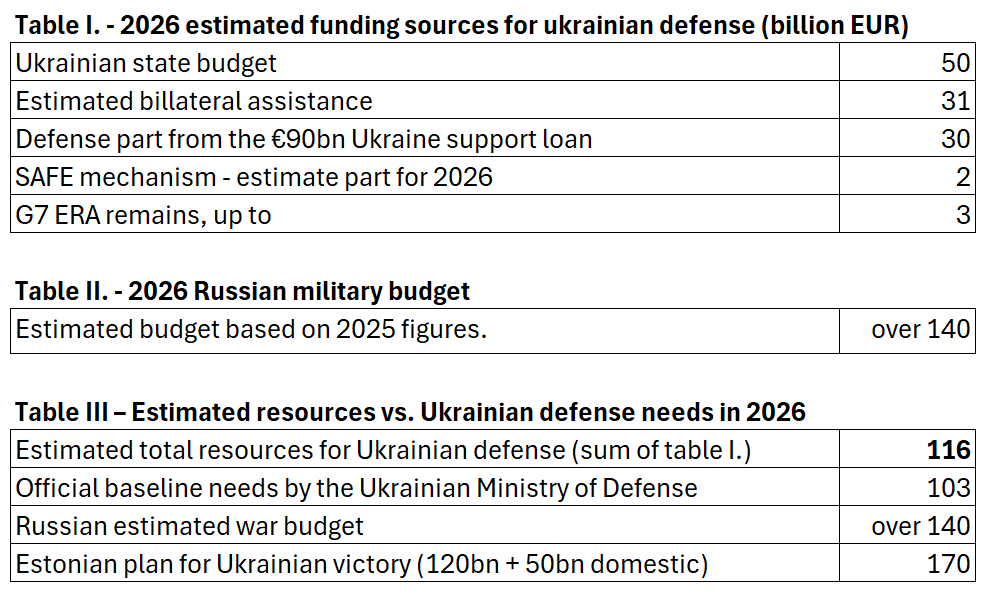
Taken together, the figures show that, thanks to a surge in institutional funding, Europe was able to more than offset the U.S. withdrawal from financial military aid in 2025. According to Ukrainian Ministry of Defense, total support reached a record €45 billion that year. For 2026, the projections point to even stronger, record-breaking assistance — roughly a 35% increase compared to the previous year.
The total for 2026 therefore reaches €116 billion. However, it is important to note that significant uncertainties remain, mainly related to Ukraine’s state budget revenues amid continued large-scale attacks on energy infrastructure continuing in January 2026. The €50 billion figure already reflects a reduced, more pessimistic scenario. Given Ukraine’s resilience and the support packages in place, the economic impact may ultimately be less severe — but budget revenue remains the key risk factor for the overall 2026 outlook.
The table shows that projected total military funding and external commitments amount to €116 billion, compared with the €103 billion minimum requested by Ukraine’s Ministry of Defense. However, Russia’s military budget exceeds €140 billion (update: the German, while the Estonian plan requires a combined level of support of around €170 billion.
Update (02/2026): German intelligence assesses that Russia’s total military and war-related spending in 2025 reached an exceptionally high €250 billion, with roughly 66% of the military budget concealed in non-defence budgetary chapters.
Summary and call to action
Ukrainian military and budgetary needs for 2026 and beyond exceed existing European commitments by tens of billions of euros, in order to halt Russian slow but steady advances.
Even with the €90 billion joint borrowing decision, Europe’s overall contribution still leaves a substantial financing shortfall — unless the EU expands joint borrowing further or finally taps immobilised Russian assets as the basis for a larger reparations mechanism, as advocated by the Make Russia Pay campaign. Using the full value of frozen Russian assets is not only a valid option in principle but the absolutely correct approach, as the aggressor should ultimately pay for the damage it has caused. We need to combine creative approaches proposed by experts in this field (like moving immobilised assets from Belgium to a new custodian under EU control as proposed by EPC analysts) with european joint borrowing to avoid any substantial delays. The joint borrowing has overcome entrenched political taboos and unanimity constraints, proven its legal and financial viability, and shall be expanded in combination with „agressor pays“ principle.
Recommendation: We propose a dual-track financial strategy to ensure Ukrainian long-term military superiority:
- Use Russian Assets Decisively: Europe must move beyond temporary interest-based solutions and explore ways to leverage the principal of immobilised Russian sovereign assets. Legal and political obstacles should be addressed with urgency to unlock immediate resources.
- Expand Joint Borrowing: The expansion of common debt instruments should proceed in parallel to avoid a funding gap. The €800 billion NextGenerationEU programme has already shown that joint borrowing is feasible when Europe faces systemic threats.
European support must match the scale of Russian war budget. By aligning financial ambition with the Estonian plan for Ukrainian victory, Europe can provide the long-term certainty needed for a decisive defence build-up. This would be one of the most important strategic investments in decades, strengthening Ukraine while reinforcing European own security.
Update 2/2026: We have prepared an open letter addressed to EU leaders and are currently gathering signatures from experts, politicians, and former public officials.
The final section of this paper presents one more argument for why timely and expanded investment in Ukrainian defense is not only essential for Ukraine but also for the security of European future.
General points on defence investment
Analysts warn that delaying military support for Ukraine is an expensive economic gamble; the cost of inaction far outweighs the price of decisive investment today. According to a 2025 study by Corisk and the Norwegian Institute of International Affairs (NUPI), a Russian victory could impose total costs of €1.2–1.6 trillion on Europe over four years due to massive refugee flows, accelerated rearmament of NATO’s eastern flank, and defensive expenditures. In contrast, enabling a Ukrainian victory is estimated to cost €522–838 billion over the same period—roughly half the price of a Russian win. This stark math highlights that spending more now to help Ukraine prevail could save Europe hundreds of billions of euros while significantly reducing long-term security risks.
Short-term commitments for military equipment for Ukraine should be financed with additional debt. That’s the way wars have historically been funded.
Gunther Wolff, a senior fellow at the Brussels-based think tank Bruegel, told DW in article Ukraine war: The trillion-dollar cost to the West:
Published: 22 January 2026
Author: Michal Majzner, Občanský rozcestník (Civic Signpost initiative, Czech Republic)